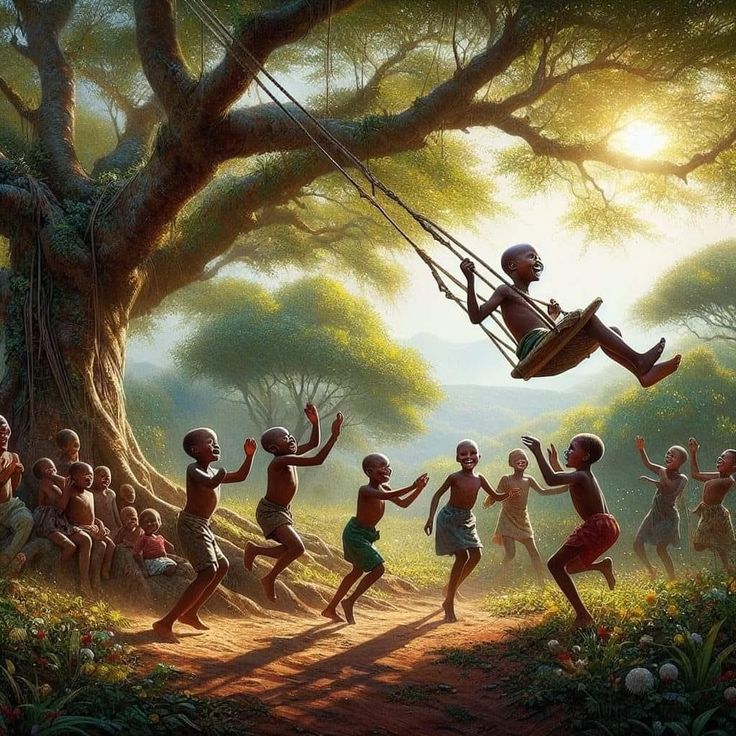
🌳 Chapter One – The Village Playground
In the village of Umuoma, there was one place every child loved more than anywhere else. It was the wide shade beneath an enormous old tree that stood at the edge of the village.
The tree was so big that many children could sit beneath it without touching one another. Its branches stretched far across the sky, and during the hot afternoons, its thick leaves protected the children from the burning sun.
But the tree was not famous because of its size alone. It was famous because it was the village playground.
Every morning, as soon as the children finished their breakfast, they began thinking about the same thing.
“Are you going to the playground today?”
“Of course!”
“Then I will beat you there!”
Sometimes, a child would hear the sound of other children running past his house and immediately jump up.
“Mama, I am going outside!”
“Outside to do what?”
“To play!”
“Have you finished your chores?”
The child would suddenly become quiet.
“Not yet.”
“Then finish them first.”
But that did not stop some of them from trying to escape.
There were children who would sweep half the compound, hide the broom behind the house and quietly disappear. Others would carry a bucket halfway to the stream, drop it somewhere along the path and run toward the playground.
They all wanted one thing.
They wanted to be the first child under the tree.
As soon as the first child arrived, he would shout,
“I am here! Who is coming next?”
Before long, another child would appear from the narrow path leading from the farms. Then another would come running from the houses near the stream. Soon, children would begin appearing from every direction.
Some came barefoot.
Some came laughing.
Some came carrying sticks, ropes or small pieces of wood they had turned into toys.
The moment they reached the tree, nobody cared where they had come from. They were all part of the same game.
The children had many games, but one rule remained the same.
Everyone had to take turns.
When one child finished, another stepped forward. When one team won, the losing team waited for its turn to challenge them again.
There was always shouting.
There was always laughter.
And there was always someone saying, “That is not fair! Let me try again!”
The children could play for hours without noticing how quickly the sun was moving across the sky.
Sometimes their mothers would call from far away.
“Come home and eat!”
“I am coming!”
But the voice would become weaker as the child continued playing.
Another hour would pass.
Then another.
Some children became so carried away that they completely forgot about food.
Their stomachs would growl, but they would simply say, “After this round.”
Then another round would begin.
The most exciting moment came whenever they decided to choose a winner.
Everyone gathered around the tree and watched closely.
The children cheered for their friends. Some jumped up and down. Others clapped their hands as loudly as they could.
When the final winner was announced, the playground would explode with excitement.
“Champion!”
“Champion!”
“Champion!”
The winner would stand proudly in the middle of the children, smiling from ear to ear.
Sometimes the winner would even be carried on the shoulders of friends while everyone followed behind, laughing and celebrating.
But nobody stayed a winner forever.
The next day, another child might take the crown.
And that was what made the playground special.
Nobody was too important to play with anyone else. The rich played with the poor. The older children played with the younger ones. Boys and girls ran together, laughed together and competed together.
Under that great old tree, the children forgot about everything else.
They forgot about the chores waiting at home.
They forgot about the food waiting on the table.
They forgot about the time.
All they wanted was one more game.
And as the evening sun began to disappear behind the hills, the children would slowly hear their mothers calling their names from different parts of the village.
“Chinedu!”
“Amara!”
“Obinna!”
“Come home!”
The children would look at one another.
“One last game?”
“One last game!”
And under the old tree, the laughter would begin all over again.
🌙 End of Chapter One
🏃 Chapter Two – The Children Who Could Not Wait
The next morning, the village had barely woken up when the children were already thinking about the playground.
Some had not even finished washing their faces.
Some were still eating.
And some were already standing outside their houses, looking toward the big tree.
They knew that another day of games was waiting for them.
Among all the children, there was one boy named Nnamdi.
Nnamdi loved the playground more than anyone.
He was always trying to reach the tree before everyone else.
Every morning, he would wake up and listen carefully.
The moment he heard children running along the village path, he would jump out of bed.
His mother, Mama Ngozi, knew exactly what he was thinking.
“Nnamdi, where are you going?”
“To the playground.”
“Have you swept the compound?”
Nnamdi looked at the broom.
Then he looked toward the road.
Then he looked at his mother.
“I will do it when I come back.”
His mother shook her head.
“You said that yesterday.”
Nnamdi smiled.
“Today will be different.”
Before his mother could answer, he ran away.
“Nnamdi!”
But he was already gone.
He ran through the narrow path with all his strength.
He passed the old well.
He passed the cassava farm.
He passed two boys who were also running toward the playground.
“I will beat you!” Nnamdi shouted.
“You wish!” one of the boys answered.
They all ran faster.
When Nnamdi reached the tree, he stopped and laughed.
“I am first!”
But a small girl was already sitting under the tree.
Nnamdi stared at her.
“How did you get here?”
The girl smiled.
“I woke up early.”
Her name was Adaeze.
She was one of the best runners in the village.
Nnamdi pointed at her.
“You cheated.”
Adaeze laughed.
“I did not cheat. I only ran faster than you.”
Soon, the other children arrived.
The playground became noisy.
Some children wanted to race.
Others wanted to play with the rope.
Some wanted to play a game where two teams would compete against each other.
They argued for a while about which game should come first.
Then an older girl named Ifeoma stood up.
“We will take turns.”
Everyone became quiet.
“First, the runners will race.”
“After that, the rope game.”
“Then the teams will play.”
Nobody complained.
The first race began.
The children stood beside the tree.
Ifeoma counted.
“One!”
“Two!”
“Three!”
They ran.
Their feet hit the dusty ground.
The children under the tree screamed and cheered.
“Run!”
“Faster!”
“Do not stop!”
Adaeze ran like the wind.
Nnamdi was close behind her.
For a moment, it looked like he might pass her.
But Adaeze pushed harder.
She reached the finish line first.
Everyone shouted.
“Adaeze!”
“Adaeze!”
“Adaeze!”
She smiled proudly.
Nnamdi laughed and shook his head.
“Tomorrow I will win.”
Adaeze replied,
“You have been saying that for one month.”
Everyone laughed.
The day continued.
They played one game after another.
Nobody noticed that the sun had moved far across the sky.
Around midday, one of the younger boys complained.
“I am hungry.”
“Go home and eat,” Ifeoma said.
The boy looked at the game.
“I will eat later.”
That became the common answer.
Later.
Later.
Later.
Some children had mothers waiting for them at home.
Some had chores waiting.
But once they reached the playground, it was difficult for them to leave.
There was always another game.
Another race.
Another challenge.
Another chance to become champion.
One afternoon, something happened that nobody expected.
The children were playing near the far side of the tree when they heard a strange sound.
A loud crack came from one of the branches.
Everyone stopped.
The tree moved slightly.
The children looked upward.
A large dry branch was hanging above the place where they normally played.
Nobody moved.
Then the branch fell.
It crashed onto the ground.
Dust filled the air.
The children screamed and ran backward.
For a few seconds, nobody spoke.
Then Nnamdi said,
“What if we were sitting there?”
Adaeze looked at the fallen branch.
“We could have been hurt.”
The children became quiet.
The playground that had always felt safe suddenly looked different.
Ifeoma looked around.
“We should tell the elders.”
Everyone agreed.
That evening, the children went home earlier than usual.
They told their parents what had happened.
The news quickly spread through the village.
The elders came to inspect the tree.
They looked at the fallen branch.
Then they looked at the other branches above the playground.
One of the elders shook his head.
“This tree needs attention.”
The villagers gathered the next morning.
The children stood nearby and watched.
The men cut away the weak branches.
The women cleared the dry leaves.
The children helped by carrying small pieces of wood away from the playground.
When the work was finished, the playground looked safer than before.
The children cheered.
But the elders gave them a warning.
“Never play beneath a weak branch.”
The children promised.
From that day, they learned something new.
The playground was their happy place.
But they also had to protect it.
They began checking the tree before they played.
They removed dangerous sticks.
They kept the ground clean.
And whenever they saw something unsafe, they told an adult.
Still, their love for the playground did not change.
Every morning, they returned.
They still raced.
They still laughed.
They still celebrated their winners.
And they still argued about who would win the next game.
But now they understood that the place they loved needed their care too.
🌙 End of Chapter Two
🌿 Chapter Three – The Day Everything Changed
After the elders had repaired the playground, the children became even more careful with their favorite place.
Every morning, before the first game started, someone would walk around the big tree and check the ground.
“Look properly,” Ifeoma would say.
“Make sure there is no broken branch.”
The others would laugh.
“We know!”
But they still checked.
The playground soon became cleaner and more beautiful than it had ever been.
The children even started making their own rules.
Nobody was allowed to push another child.
Nobody was allowed to cheat.
And nobody could remain the champion forever without giving another child a chance.
The children agreed that everyone had to take turns.
At first, the rule was not easy.
Nnamdi hated losing.
Whenever another child defeated him, he would cross his arms and walk away.
One afternoon, he lost a running race to a small boy named Chuka.
Chuka was much younger than Nnamdi, so everyone was surprised.
When the children shouted Chuka's name, Nnamdi became quiet.
Ifeoma walked toward him.
“You should congratulate him.”
Nnamdi looked at Chuka.
Then he smiled.
“You ran very well.”
Chuka smiled back.
“Thank you.”
That small moment changed something among the children.
They began to understand that winning was not the only important thing.
Sometimes, the best part was seeing another person do well.
The games became more exciting.
The children began helping one another.
The older children taught the younger ones how to run.
They showed them how to jump.
They taught them how to play the different games.
And when someone fell, another child would quickly help them stand.
The playground became more than a place for games.
It became a place where friendships grew.
One Saturday afternoon, the children decided to organize the biggest competition they had ever held.
There would be running.
Jumping.
Rope games.
Team games.
And a final competition where the strongest players would face one another.
Everyone wanted to win.
Even children who normally watched from under the tree decided to join.
The news spread quickly through the village.
Parents came to watch.
Older brothers and sisters came.
Even some of the elders sat nearby under another tree to watch the children play.
The competition started in the afternoon.
The first race was loud.
The second was even louder.
By the time the team games started, almost the whole village had gathered around the playground.
Children shouted from every direction.
“Go!”
“Run!”
“Do not stop!”
“Your team is winning!”
The excitement was everywhere.
Then came the final game.
Nnamdi was one of the players.
Adaeze was there too.
Chuka stood with the younger children, cheering for them.
The final game was close.
Nobody knew who would win.
Nnamdi's team moved forward.
Adaeze's team answered.
The children ran from one side to the other.
The crowd shouted.
Even the elders were smiling.
Then suddenly, one of the youngest children slipped.
He fell hard on the ground.
The game stopped immediately.
Before anyone could call for help, Nnamdi ran toward him.
Adaeze followed.
They helped the boy stand.
“Are you hurt?”
The boy shook his head.
“My knee.”
Nnamdi looked at it.
“We will take you to your mother.”
The competition no longer mattered to them.
They carried the boy away from the playground.
The crowd became quiet.
One of the elders smiled.
“That is what we want to see.”
Another elder nodded.
“Children who know how to care for one another will grow into good people.”
The game continued later.
But something had changed.
The children were no longer playing only to become champions.
They were playing together.
They were learning together.
And they were growing together.
When the final winner was announced, everyone celebrated.
But the winner did not stand alone.
The children gathered around him.
They clapped.
They laughed.
They danced around the big tree.
Nnamdi looked at the playground and smiled.
He suddenly remembered the days when he used to run away from his chores just to arrive first.
He remembered how angry he became whenever he lost.
Now he understood something.
The playground was not about being first.
It was about being together.
As the evening came, the parents began calling their children home.
One by one, the children picked up their things.
Some were tired.
Some were hungry.
Some were still arguing about who had really won.
But they all left with smiles on their faces.
Nnamdi was one of the last to leave.
He looked back at the big tree.
“See you tomorrow,” he said.
Adaeze laughed.
“You better come early.”
Nnamdi smiled.
“I will.”
The children walked home through the quiet village paths.
Behind them, the old tree stood silently in the evening light.
The playground was empty for the night.
But everyone knew that when the sun rose again, the laughter would return.
🌙 End of Chapter Three
🪢 Chapter Four – The Secret of the Playground
🌳 End of Chapter Four
🌅 Chapter Five – The Playground That United the Village
Many years passed, but the big tree remained standing at the edge of the village.
The children who once ran beneath it every morning were no longer small children.
Nnamdi had grown taller.
Adaeze had become a strong young woman.
Ifeoma was now helping the younger children learn the games.
Even Chuka, who was once the smallest boy among them, had grown into one of the fastest runners in the village.
But one thing had not changed.
The playground was still full of laughter.
New children now played under the same tree.
They ran along the same dusty paths.
They made the same loud noise.
And they still argued about who was the best player.
One evening, Nnamdi returned to the playground after being away for many months.
He stood beneath the old tree and looked around.
The place brought back many memories.
He remembered the races.
He remembered losing to Adaeze.
He remembered trying to escape from his chores just to reach the playground first.
He remembered the day the branch fell.
He remembered the little boy who fell during the big competition.
And he remembered the first time he learned that winning was not everything.
Adaeze walked toward him.
“You came back.”
Nnamdi smiled.
“I had to.”
“Why?”
He looked at the children playing under the tree.
“Because this place is still part of me.”
Adaeze smiled.
“It is part of all of us.”
They watched the children for a while.
A group of boys were racing.
Some girls were playing a rope game.
The younger children were sitting beneath the tree and cheering.
Then one little boy shouted,
“I won!”
The children around him started cheering.
“Champion!”
“Champion!”
The boy smiled proudly.
Nnamdi laughed.
“Nothing has changed.”
Adaeze shook her head.
“Everything has changed.”
Nnamdi looked at her.
She pointed at the children.
“We have new children now. But they are making the same memories we made.”
That evening, the village chief called everyone together.
The elders, parents and children gathered near the playground.
The chief stood beneath the old tree.
“This tree has watched many generations grow.”
Everyone became quiet.
“Your parents played here.”
“Your older brothers and sisters played here.”
“And now you play here.”
He looked at the children.
“But the most important thing is not the games.”
The children listened.
“It is what you learn while playing together.”
He pointed toward the children.
“You learn how to take turns.”
“You learn how to accept defeat.”
“You learn how to celebrate another person's victory.”
“You learn how to help someone who falls.”
“And you learn that friendship is more important than winning every game.”
The children nodded.
The chief then announced something that made everyone happy.
The village would keep the playground for future generations.
The villagers would repair the tree area whenever it needed care.
They would keep the ground clean.
They would make sure the children were safe.
And every year, they would hold a great village playground celebration.
The children screamed with joy.
“That means we can play all day!”
Everyone laughed.
The first celebration was held a few weeks later.
People came from different parts of the village.
Parents brought food.
The women prepared drinks.
The men helped prepare the playing area.
The children were ready from early morning.
There were races.
There were team games.
There were rope games.
There was dancing.
There was singing.
And there was plenty of laughter.
The children played until the afternoon.
When the final game ended, everyone gathered beneath the big tree.
The winners were called forward.
Each winner received a small gift.
But the biggest celebration was not for the person who won the most games.
It was for the children who helped others.
The village chief called them forward too.
“These are the children who helped their friends.”
“These are the children who gave others a chance.”
“These are the children who showed us that kindness is also a victory.”
The whole village clapped.
The children smiled.
Some were shy.
Some laughed.
But they were all happy.
As evening came, the sun slowly disappeared behind the hills.
The children sat beneath the tree, tired but happy.
Nnamdi looked around one last time.
He remembered the little boy he used to be.
A boy who only wanted to win.
A boy who forgot his chores.
A boy who sometimes forgot to eat because he wanted one more game.
Now he understood why the playground had been so important.
It had taught him things that no classroom could teach him in the same way.
It taught him friendship.
It taught him patience.
It taught him how to lose and try again.
It taught him how to win without looking down on others.
Most of all, it taught him that happiness becomes greater when it is shared.
Adaeze sat beside him.
“Are you coming tomorrow?”
Nnamdi laughed.
“Of course.”
“You will still try to beat me?”
“Of course.”
They both laughed.
Around them, the children were already talking about the next day's games.
Someone shouted,
“I will be the champion tomorrow!”
Another child answered,
“Not if I get there first!”
The laughter started again.
The old tree stood quietly above them.
Its branches moved gently with the evening wind.
The playground was once again full of happy voices.
And the village knew that the laughter would continue for many more years.
🌿 Moral of the Story
The joy of playing together is greater than winning alone. We should learn to take turns, help others, accept defeat, celebrate people's success and care for the places that bring our community together.
📖 The End
🌙 End of Chapter Five